
Grammatical and Textual witnesses’ survey to include in the workbook
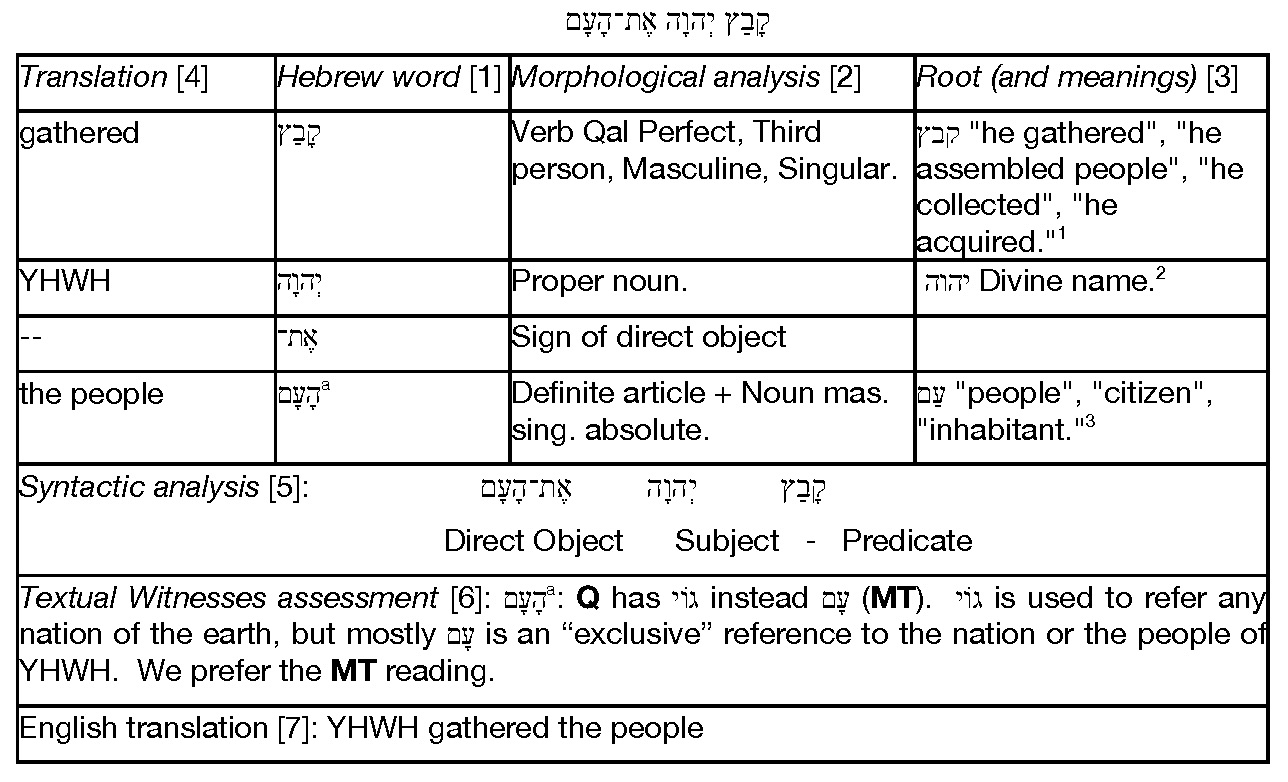
[1]David J.A. Clines, “קבץ”, The Concise Dictionary of Classical Hebrew (Sheffield: Sheffield Phoenix Press, 2009), 387.
[2]Ludwing Koehler and Walter Baumgartner, “יהוה”, The Hebrew and Aramaic of the Old Testament (Leiden/Cologne/New York: Brill, 1994-2000), 2:394.
[3]William Lee Holladay and Ludwig Köhler, “עַם” A Concise Hebrew and Aramaic Lexicon of the Old Testament (Leiden: Brill, 2000), 275.
Textual analysis of Isa 40:1 (Including Textual Witnesses)
נַחֲמוּ נַחֲמוּ עַמִּי יֹאמַר אֱלֹהֵיכֶם
first clause: נַחֲמוּ נַחֲמוּ עַמִּי
Second clause: יֹאמַר אֱלֹהֵיכֶם
נַחֲמוּ נַחֲמוּ
נחם > (Morphology): Verb Piel imperative masculine plural.
§ A Concise Hebrew and Aramaic Lexicon of the Old Testament (hereafter CHALOT), 234 > Nif. “Regret, be sorry, comfort, console.”
§ The Hebrew and Aramaic Lexicon of the Old Testament (hereafter HALOT), 2:689 > to comfort (with words); “to comfort does not mean to sympathise but to encourage.” As conclusion to the period of mourning (2 Sam 12:24).
§ The Dictionary of Classical Hebrew (hereafter DCH) 5:664 > “to vindicate.”
נחם in other Biblical contexts
“Therefore I say, ‘Turn your eyes away from me, Let me weep bitterly, Do not try to comfort me concerning the destruction of the daughter of my people.’” –Isa 22:4 (Translations in these references belong to the NASB).
“Then all his brothers and all his sisters and all who had known him before came to him, and they ate bread with him in his house; and they consoled him and comforted him for all the adversities that the LORD had brought on him.” –Job 42:11.
“As one whom his mother comforts, so I will comfort you; And you will be comforted in Jerusalem.” –Isa 66:13.
נַחֲמוּ (working translation): [you] console!/comfort! (2x)
עַמִּי
עַם > (Morph.): Noun common masculine.
§ CHALOT, 275 > People (emphasis on internal ethnic solidarity). Inhabitants (not a whole people but a portion).
§ HALOT, 2:837 > A: paternal uncle; B: (paternal) relations, clan, kin; C: people (with an emphasis on connections of kinship and religious ceremonial).
§ DCH, 6:431 > People, nation, compatriots.
עַם in other sections of the Book
“An ox knows its owner, and a donkey its master’s manger, But Israel does not know, my people do not understand.” –Isa 1:3.
“Therefore my people go into exile for their lack of knowledge; And their honorable men are famished, And their multitude is parched with thirst.” –Isa 5:13.
“Then the Lord said, “Because this people draw near with their words and honor Me with their lip service, but they remove their hearts far from Me,” –Isa 29:13.
עַמִּי (working translation): “my people.”
Syntactical analysis – first clause
נַחֲמוּ נַחֲמוּ עַמִּי
Obj.+ Predicate
Second clause
יֹאמַר
אמר > (Morph.): Verb qal imperfect third masculine singular.
§ CHALOT 21 > “say, call, promise, think, intend.”
§ HALOT 1:65-6 > “to say, to make know.”
§ DCH 1:321 > “answer, reply respond to, speak (= דבר piel), “mention someone; declare.” “Command, order, tell someone to do something.”
יֹאמַר (working translation): [he] says.
אֱלֹהֵיכֶם
אֱלֹהִים > (Morph.): Noun common masculine plural construct +
Pron. Suffix second masculine plural.
§ CHALOT, 17 > “God, deity.”
§ HALOT, 1:52 > “god,” (any god at all) 2Chr 32:15. The true God.
§ DCH, 1:278 > “God, other god(s), divine being, deity.” Isa 37:19.
The word is used 2600 times in the Hebrew Scriptures (hereafter HS), 94 times in Isaiah.
אֱלֹהִים in other sections of the Book
“A voice is calling, ‘Clear the way for the LORD in the wilderness; Make smooth in the desert a highway for our God.’” –Isa 40:3 NASB.
“The grass withers, the flower fades, But the word of our God stands forever.” –Isa 40:8.
“Why do you say, O Jacob, and assert, O Israel, “My way is hidden from the LORD, And the justice due me escapes the notice of my God?” –Isa 40:27.
“Do you not know? Have you not heard? The Everlasting God, the LORD, the Creator of the ends of the earth. Does not become weary or tired. His understanding is inscrutable. –Isa 40:28.
אֱלֹהֵיכֶם (working translation): [from you (plural)] your God.
Syntactical analysis second clause
יֹאמַר אֱלֹהֵיכֶם
Subject+Predicate
Textual Witnesses
Dead Sea Scrolls – 1QIsaa
יואמר אלוהיכמה
Comments: The two words in the sentence are written by using matres lectionis vowels.
Targum Jonathan to the Prophets
נְבִיַיָא אִתנַבוֹ תַנחוּמִין עַל עַמִי אְמַר אְלָהְכוֹן
Comments: Targum includes new words in the sentence.
נְבִיַיָא > “prophets.”
אִתנַבוֹ > “prophesy.”
תַנחוּמִין > “consolation.” It uses a noun instead a verb Imperative as in the Masoretic Text (MT)
Working translation: “Prophets, prophesy consolation over my people, Your God says.”
LXX – Ralhfs Edition
Παρακαλεῖτε παρακαλεῖτε τὸν λαόν μου, λέγει ὁ θεός
§ A Greek-English Lexicon of the New Testament and other Early Christian Literature (hereafter BDAG), 764. παρακαλέω > “to urge strongly, appeal to, urge, exhort, encourage; to instill someone with courage, comfort, encourage.” (cf. Isa 61:2).
BHS – Critical Apparatus
No remarks in the BHS Critical Apparatus.
Translation Isa 40:1
נַחֲמוּ נַחֲמוּ עַמִּי יֹאמַר אֱלֹהֵיכֶם
“Comfort, comfort My people, your God says.”